going underground

Tuesday, 21 September 2010

We were out and about in the Big Smoke this morning and the Underground of all places gave us some good old fashioned inspiration for today's post.  As we were winging our way around town post-rush hour we managed to bag a seat;  a good old fashioned moquette covered seat.  So we thought we'd do a piece on London Underground's infamous connection with moquette.

Here are a few of our favourite designs from yesteryear.


'Colindale' or 'Leaf ' was designed by Marion Dorn in 1937 and features a stylised leaf pattern. The design was produced for London Passenger Transport Board in several different colourways and was first used on Tube stock in 1938 and it was used on the Northern line in 1939.

The 'Double Diamond' is another pattern in greens and reds used in the late1930s and 1940s. Officially called 'Brent', the fabric was designed by Enid Marx in around 1937.

The 'Chevron' design is a geometric pattern consisting of a light green grid overlaid by diagonal red stripes and checks in the form of a 'chevron', on a dark green background.  Designed by Enid Marx in 1938, this moquette was used to re-upholster seats on 1938 Surface Stock trains. On vehicles for the Piccadilly and Central lines it was teamed with red leather arm rests.

'Shield' is a repeating geometric pattern of interlocked diamond and lozenge shapes in red and light green on a dark green background.  Again designed by Enid Marx, this time in 1945, it is believed moquette of this pattern was widely used on the refurbished 1938 stock from 1945. It was teamed with green leather armrests on vehicles for the Bakerloo, Northern and District lines.

The 'Roundel'  design features a circle with light and dark green sections overlaid with a red roundel motif within another red circle. This is mounted diagonally within a diamond pattern formed from red, light green and dark green lines.  Designed by Eddie Chapman in 1947, it is not known exactly what vehicles this moquette was used on.  However, it is believed that it may have been used during a refurbishment of 1938 stock Underground trains.

This tartan style fabric was designed by industrial designer Douglas Scott, who was responsible for the interior and exterior styling of the Routemaster bus. The pattern features horizontal bands of maroon, brown and light green pile interspersed with vertical lines of yellow loop pile. It was designed specifically to echo the interior colour scheme of the vehicle: yellow ceilings, red lower sides and green seat backs.

Want to know more ...... well London Transport Museum is holding a "Moquette For London" design evening on Wednesday 22 September 2010.  The event will offer an insight into the moquette brand and identity, design legacy and history .......... press here for details.

Credits/Images:  London Transport Museum Shop

Saddle up

Sunday, 19 September 2010

The "Sella" was designed by Achille & Pier Giacomo Castiglioni.  Dating from 1957, it was deemed too radical to put into production until 1983.  We're soooooo glad that it was.  We've had the pleasure of sitting on one of these iconic "saddle" stools;  boy, was it fun!!


Image:  Unicahome

Saturday night fever

Saturday, 18 September 2010

As Saturday night is fast approaching we thought we'd feature a few chairs that have real disco appeal ...…. 


Commissioned by Wallpaper* Magazine, the Disco Chair was created by Kiwi & Pom, a London design studio.  The Disco Chair is a custom illuminated furniture concept.  Constructed from 200 linear meters of Electroluminescent wire, the chair transforms to a neon rainbow when powered.  A pulse setting enables the chair to flash on and off creating an instant disco installation.  Cool!


The LightBench has a lighting function and can be used either indoors or outside.  It uses technology which allows easy customisation of different colour shades.  A fixed hue or an ever changing palette of colours are options.  The user can pre-program the colour selection with an easy to use remote control.  The LightBench was designed by Lutz Hopbach and is manufactured by Frellstedt (Germany).


We haven't been able to find out anything about this chair ...... but we like, very much!


The Coron is a hand-crafted, self-illuminating light chair - just plug it in and turn it on!  The Coron's light source comes from six self-contained fluorescent fixtures that are accessible from the bottom of the chair.  The chair is made from polypropylene sheets, polished aluminium and vinyl upholstery.


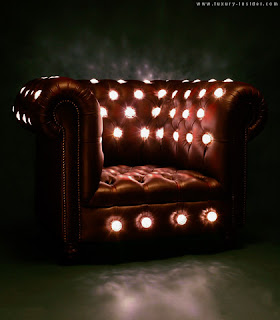
The Rough Diamond collection by Lee Broom features six neon-embellished chairs. Broom sourced vintage furniture and used light to update classic pieces into contemporary statements. The leather Club Chair takes a traditional Chesterfield but replaces the 85 buttons with fairground light bulbs.


Be careful not to sit on this one;  its a 3D neon light!


Credits/Images:  Kiwi & Pom (Disco Chair), Trend Hunter (LightBench), Opulent Items (Coron), Luxury Insider (Club Chair), Let There Be Neon (Neon Chair Light)

Come on Eileen

Friday, 17 September 2010

We thought we'd do a piece on Eileen Gray because, well, she's quite something.  Gray is now regarded as one of the most important furniture designers and architects of the early 20th century and the most influential woman in these fields.  At a time when other leading designers were almost all male and mostly members of one movement or another she remained stalwartly independent.

Here are some of our favourite pieces by the late, great, Ms Gray.

Around 1925, Gray turned her attention to Modernism and the so-called Transat Chair (1925-1929) shows her continuing interest in beautifully finished materials but the geometry of its design indicates her new direction.


Gray's Day Bed (1925) is directly attributed to the work she accomplished while commissioned by Madame Mathieu-Levy for her Parisian apartment in Rue de Lota.  It was regarded as one of the most sensational examples of French interior architecture of the 1920's.

Gray commented quite pragmatically on the Non-conformist Chair (1926) describing her work in typical understatement: "An armrest was omitted in order to leave the body more freedom in movement and to allow it to bend forward or to turn to the other side unrestricted".

Gray's voluptuous leather and tubular steel Bibendum Chair (1929) was inspired at the time by the tubular steel experiments of Marcel Breuer at the Bauhaus and is now a familiar icon.


Designed in 1932, the Roquebrune Chair was named by Gray after the house in Roquebrune for which it was originally created.

Conceived as a piece for drawing rooms, Gray found the Bonaparte Chair (1935) so pleasant that she used it for decades as her desk chair in her Paris home at Rue Bonaparte.

More butterflies

Saturday, 11 September 2010

Our first post has given us a great idea for our second.  Which butterfly is your favourite?  It's a tricky one ....... we just can't choose between the Series 7 and the Ercol.

Arne Jacobsen's Series 7 (3107) was designed in 1955. It takes nine sheets of veneer, two layers of cotton backing, up to five coats of paint and 11 days to make a 3107. Phew! It is the classic chair often designated as The Butterfly.

Launched in 1958, Ercol's Butterfly Chair showcased their extensive development work which enabled the bending of thick wood laminations to create the beautiful curves of this chair. This butterfly is beautifully crafted in beech and elm and has recently been relauched as part of the Ercol Originals range.

Pierre Paulin's Butterfly Chair dates from 1964. Still unconventional after all these years, this butterfly is Paulin's answer to The Bauhaus. A wink and a nod to Mies, Breuer and Le Corbusier?


Designed by Jorge Ferrari-Hardoy in 1938 this Butterfly Chair houses a brown leather sling seat on a steel frame.
 

chairsmith All rights reserved © Blog Milk Powered by Blogger